
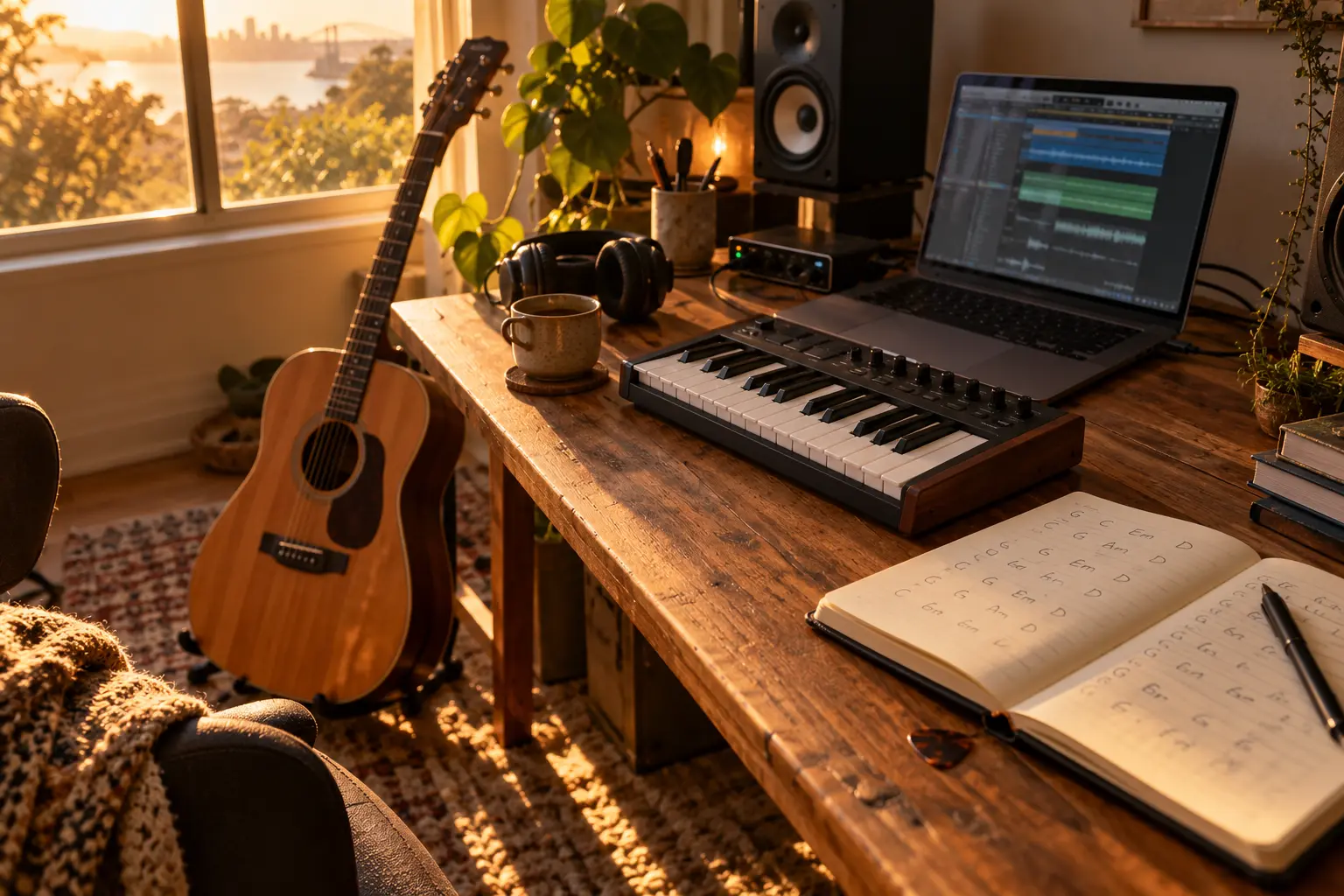
What Chord Comes Next? 4 Simple Ways to Choose the Next Chord (Piano and Guitar)
What chord comes next depends on what you want the change to do: feel solid, glide, walk somewhere or surprise the listener. Pick from the chords in your key, choose one of four simple moves, and play it before you decide. Your ear has the final say, not the rule.
Stay in your key and try one of four moves. A strong move jumps the root by a fourth or fifth (C to F, G to C). A smooth change keeps two notes the same (C to Am). A bass walk moves the bass one step. A colour chord borrows from outside the key (F to Fm) for extra emotion. In C major, F, G and Am are the safest chords to try after C.
- Most songs use the seven chords of one key, so start there.
- Four moves cover almost every next chord: strong, smooth, bass walk and colour.
- V (G in C major) usually wants to go home to I (C).
- One or two colour chords per progression is plenty. More starts to sound like a key change.
- Hear the change before you add it. A free tool can play it for you on piano or guitar.

Start with the chords in your key
A key gives you seven chords that already fit together, because they’re all built from the same seven notes. Build a three-note chord on each note of the C major scale and you get this:
| Number | Chord | Notes | What it does |
|---|---|---|---|
| I | C | C E G | Home. Sounds finished. |
| ii | Dm | D F A | Gentle step away, often leads to G |
| iii | Em | E G B | Soft, a bit dreamy |
| IV | F | F A C | Opens up, lifts the song |
| V | G | G B D | Tension that wants to go home |
| vi | Am | A C E | Sad, settled, very common |
| vii° | Bdim | B D F | Unstable, used briefly |
Capital numbers are major chords, small numbers are minor. The pattern is the same in every major key, so once you know it in C you know it in G, D or E. In a minor key the order shifts: in A minor the chords are Am, Bdim, C, Dm, Em, F and G. You can see the full set for any key on our chords in C major, chords in G major and chords in A minor pages.
Four ways to choose what chord comes next
Songwriters rarely think “I need a iii chord now”. They think about how the change should feel. These four moves cover nearly every option, and they’re the same four labels our free chord tool uses.
1. Strong move: jump the root by a fourth or fifth
This is the most natural-sounding change in Western music. G to C, C to F, Dm to G and Am to Dm all move the root this way. It sounds confident and clear, which is why the V to I change ends so many songs. Hooktheory’s analysis of the songs in its database found G is the most common chord after C in the key of C, appearing 31% of the time.
2. Smooth change: keep two notes the same
C (C E G) and Am (A C E) share two notes, so only one note moves. The change feels gentle, almost like the same chord in a different mood. C to Em works the same way (E and G stay), and so does F to Dm (F and A stay). Smooth changes are great for verses, where you don’t want the harmony to grab attention.
3. Bass walk: move the bass one step
Keep the chord, but walk the lowest note down or up by one step. C, then C with B in the bass (written C/B), then Am gives you a bass line of C, B, A. It sounds like movement even though the harmony barely changes. This is the trick behind a lot of ballads and folk songs.
4. Colour: borrow a chord from outside the key
Take a chord from the minor key with the same name. In C major that means chords like Fm, B♭ or A♭. F to Fm before going back to C is a classic bittersweet move. It works because it surprises the ear for a moment and then comes home. Use one per progression, maybe two. More than that and the song starts to sound like it changed key.
Not sure which move to try? Go strong first. If it sounds too obvious, swap it for a smooth change. If the whole thing feels flat, add one colour chord near the end of the line.
What chord comes after C, G, Am and the rest? A cheat sheet
Here’s where each chord in C major usually goes. “Safe” means a strong move that almost always works. “Smooth” shares two notes. “Colour” steps outside the key.
| Chord now | Safe next | Smooth next | Colour or surprise |
|---|---|---|---|
| C | F, G | Am, Em | Fm, B♭ |
| Dm | G | F | B♭ |
| Em | Am | C, G | A7 (leads to Dm) |
| F | C, G | Dm, Am | Fm |
| G | C | Em | Am (a “fake” ending) |
| Am | Dm | F, C | E (major) |
To use it in another key, swap the chords for their numbers. In G major, C becomes G, F becomes C, G becomes D and Am becomes Em. The moves stay the same.
A worked example: build a four-chord progression in two minutes
- Pick a key and a home chord. C major, starting on C.
- Bar 2, smooth change. C to Am. Two notes stay, the mood drops a little.
- Bar 3, smooth again. Am to F. A and C stay, the sound opens up.
- Bar 4, strong move home. F to G, and G pulls straight back to C when the loop repeats.
That’s C, Am, F, G (I, vi, IV, V), one of the most used progressions in pop. Now make it yours: swap the G in bar 4 for Fm. You get C, Am, F, Fm, and the loop suddenly sounds wistful instead of cheerful. Same first three chords, one colour change.
How to make the change sound good on piano
Beginners often jump the whole hand to each new chord in root position. It works, but it sounds blocky. Two habits fix most of it:
- Keep shared notes where they are. Going from C (C E G) to Am, leave C and E in place and move G up to A. One finger moves instead of three.
- Use inversions to stay close. F doesn’t have to start on F. Play it as C F A (an inversion) right after C E G and your hand barely moves.
Put the root of each chord in your left hand and let the right hand take the shortest path. That’s how most pianists play a progression, and it sounds smoother straight away.

How to make it easy on guitar
The key of C is friendly on guitar except for one chord: F. The full F barre chord stops a lot of beginners. You don’t need it to start. Play F on the top four strings only (x x 3 2 1 1) or even the top three (x x 3 2 1 x) and the progression still works.
A capo helps when a key is awkward. Want to play in A but only know G shapes? Put a capo on fret 2 and play G, Em, C and D shapes. They’ll sound as A, F♯m, D and E, which is the same progression two steps higher.
Common mistakes: looping I and V for a whole song with nothing in between, ending a line on V without ever going home, piling up colour chords until the key disappears, and writing chords without checking them against the melody you’ll actually sing.
Find your next chord with our free tool
Theory narrows what chord comes next down to three or four good options. Your ear picks the one. That’s why we built the 10dB Piano and Guitar Chord Finder, a free chord progression tool that runs in your browser with no sign-up. Pick a key and it suggests what fits next, labelled Strong, Smooth, Bass walk and Colour, exactly like the moves above. Tap any idea to hear the change before you add it.
- Choose a key. Pick the home note and major or minor. Tap Play to hear the scale.
- Add your first chord. Tap Next chord and choose from the suggestions.
- Check Fits next. Every idea is tagged Strong, Smooth, Bass walk or Colour. Tap one to hear it.
- See how to play it. Piano keys, or a guitar diagram with tab, easy shapes and capo options.
- Take it further. Play the loop at any tempo, share it with a link, or export MIDI into your DAW.
Not sure which keyboard suits your setup? Our guide to choosing the right MIDI controller covers key count, size and connections.
Frequently asked questions
What chord usually comes after C?
In the key of C major, G, F and Am are the most common choices. G and F are strong moves, Am is a smooth change because it shares C and E with the C chord.
What chord comes after G?
In C major, G almost always wants to go to C, which sounds like coming home. If you’d rather delay that, go to Am instead. It’s called a deceptive cadence and it keeps the song moving.
How many chords should a progression have?
Most pop and rock progressions use three or four chords that repeat. Four bars, one chord per bar, is an easy place to start. You can always add a passing chord later.
Can I use chords that aren’t in the key?
Yes. Borrowed chords like Fm or B♭ in C major are used all the time for colour. Keep it to one or two per progression and lead back to a chord from the key straight after.
How do I work out what chord comes next in a song by ear?
Find the key first by humming the note that feels like home. Then try the safe chords against the recording: IV, V and vi cover most of the options. If none fit, try a smooth change before reaching outside the key.
Do I need music theory to write chord progressions?
No. Knowing the seven chords in your key and the four moves in this guide is enough to write full songs. The rest is listening and trying things.
Got a progression you like? Record it.
A small MIDI keyboard lets you play your chords straight into any DAW, and most fit next to a laptop.
Off The Record: 12 studio secrets nobody bothers to tell you
Why does the radio sound huge while your song sounds small? This free guide answers that and eleven other questions, with simple steps you can try in your next session.
