

sE V7 vs SM58: The Real Difference Between These Two Vocal Mics (and Where Your Monitor Should Go)
The sE V7 vs SM58 question comes down to one thing most comparisons skip: the pickup pattern. Both are dynamic handheld vocal mics built for loud stages, but the SM58 is cardioid and the V7 is supercardioid, and that changes how you hold the mic and where your foldback wedge should sit.
Pick the sE V7 if you sing on a loud stage, keep the mic pointed at your mouth and can put the wedges where they belong. It rejects more sound from the sides and gives more level before feedback. Pick the SM58 if you move around, hold the mic loosely or play venues where the wedge always sits straight in front of you. The SM58 is more forgiving of sloppy technique.

sE V7 vs SM58 specs side by side
On paper they’re close. Both are moving coil dynamics with an XLR output, both weigh about 300 g and both need a decent amount of preamp gain. The useful differences are in the pattern and the build.
| sE Electronics V7 | Shure SM58 | |
|---|---|---|
| Type | Dynamic | Dynamic |
| Polar pattern | Supercardioid | Cardioid |
| Rated frequency range | 40 Hz to 19 kHz | 50 Hz to 15 kHz |
| Impedance | 300 ohms | Rated 150 ohms (300 ohms actual) |
| Weight | 305 g | 298 g |
| Body | All metal, zinc alloy chassis | Metal body, steel mesh grille |
| Shock mount | Integrated shockmount | Pneumatic shock mount |
| Pop protection | Switchable internal windscreen | Built in spherical filter |
| Connector | Gold plated 3-pin XLR | 3-pin XLR |
Don’t read too much into the frequency range. On a vocal mic held a few centimetres from your mouth, the shape of the presence boost and the proximity effect matter far more than where the response finally drops off.
Cardioid vs supercardioid: why the V7 behaves differently on stage
A cardioid mic like the SM58 is least sensitive directly behind it, at 180 degrees. A supercardioid like the V7 has a narrower front pickup, so it ignores more of the drummer and the guitar amp beside you. The catch is a small lobe of sensitivity at the back. Its quietest points sit at roughly 125 degrees off axis, not straight behind.
That’s why the V7 gets more level before feedback in the right setup. Sound On Sound’s review found it allowed noticeably more level before feedback than sE’s cheaper V3. The same narrow pattern is also why it can squeal in the wrong setup.
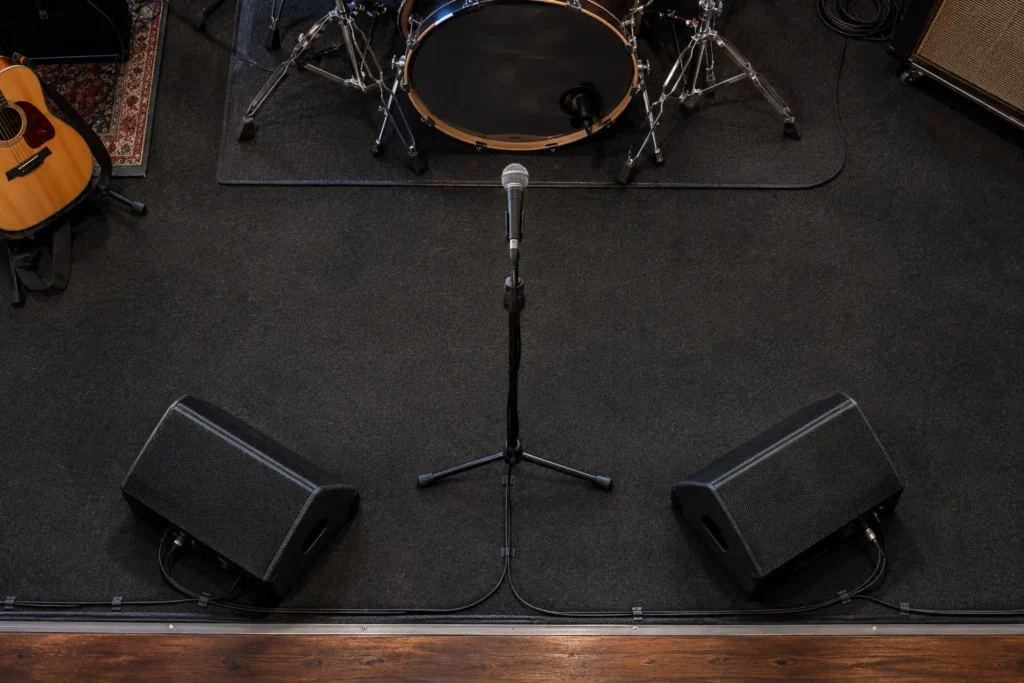
The classic mistake: putting a single wedge dead centre in front of a singer using a supercardioid mic. That aims the speaker into the mic’s rear lobe. Move the wedge off to one side, or use two wedges angled in from the left and right, so they sit near the mic’s quiet zones.
With an SM58 the old rule still works. Put the wedge straight in front of you, which places it directly behind the mic where the cardioid is least sensitive. Shure’s own SM58 user guide says to place monitors directly behind the mic and to test the placement before every show.
How do they sound?
The SM58 has the sound most people already know: a solid midrange, a gentle presence lift and a rounded top. It’s flattering on a lot of voices and very hard to make sound bad, which is a big part of why it’s been the default live vocal mic since 1966.
The V7 sounds more open at the top. Sound On Sound measured its presence boost as two gentle humps centred near 3.5 kHz and 10 kHz, plus a low frequency roll-off to keep close-up singing from getting boomy. Plenty of users describe it as clearer than an SM58 on their voice. Not everyone agrees. A minority of reviewers prefer the SM58 and hear a low-mid bump in the V7 they don’t like.
So neither is “better” in every case. If your voice gets lost in a dense band mix, the V7’s extra air can help it cut through. If your voice is already bright or harsh, the SM58 may be kinder.
Mic technique: which one forgives you more?
The SM58 is the forgiving one. Sing a little off to the side, drop the mic to your chin between lines or hold it at a slight angle, and the level and tone don’t fall apart.
The V7 rewards discipline. Several users describe its sweet spot as smaller and more pinpointed than the SM58’s. Keep it pointed at your mouth, a few centimetres away, and it sounds great. Wave it around and your level will jump.
Both mics get bassier the closer you sing. Shure notes that within about 15 cm you get a fuller sound with more bass, and that right up on the grille the bass below 100 Hz can rise by 6 to 10 dB. Use that on purpose. Back off for loud notes and lean in for intimate ones.
Whichever mic you use, switch on the high-pass filter on your mixer channel, starting around 80 to 100 Hz. It cleans up handling thumps and stage rumble without thinning out the voice.
Build, handling noise and the little details
The SM58’s reputation for surviving drops and years on the road is earned. Its capsule sits in a pneumatic shock mount, and it’s one of the main reasons it has stayed on stages for decades.
The V7 is built just as solidly. According to sE Electronics, the chassis is all metal with no plastic parts, and the spring steel grille has a bevelled edge so the mic won’t roll off a table. It also comes with a switchable internal windscreen and a carry pouch. User reports on its handling noise are mixed. Most find it low, but a few hear more thump than they expected, which is another reason to use that high-pass filter.
Which one should you buy?
- Loud band, you control the wedges: sE V7. The tighter pattern and extra gain before feedback are worth it.
- Venue mic or shared mic: SM58. It works for singers with good and bad technique, and with wedges wherever the venue puts them.
- Singer who moves and gestures a lot: SM58.
- Voice that gets buried in the mix: try the V7 first.
- Home recording or podcasting in an untreated room: either works, and both beat a condenser for rejecting room noise. Your interface needs enough clean gain for a dynamic mic.
Already running a Shure wireless system? sE makes the V7 as a capsule (the V7 MC1) that fits select Shure handheld transmitters, so you can try the V7 sound without replacing the whole system.
Buying in Australia: watch out for fake SM58s
The SM58 is one of the most counterfeited mics in the world. Most fakes do work, but they sound worse and usually lack the pneumatic shock mount. If a price looks too good, it usually is. Buy from an authorised Australian dealer and check the packaging and the grille fit.
The SM58 is still the safest all-rounder, and it’s the mic we’d hand to a stranger at an open mic night. If you sing in a loud band, hold your mic properly and can set your wedges up for a supercardioid, the sE V7 gives you more clarity and more level before feedback for similar money.
Want more on getting the V7 right on stage? Read our sE V7 live vocal tips. Recording speech instead of singing? Our guide to the best microphone for podcasting covers that.
Frequently asked questions
Is the sE V7 better than the SM58?
For a disciplined singer on a loud stage with well placed wedges, many people find it clearer with more gain before feedback. For venue use, shared mics or singers who move around, the SM58’s wider pattern is easier to live with. Better depends on the stage, not the spec sheet.
Does the sE V7 need more gain than an SM58?
Their rated outputs are in the same range, but some users report turning the V7 up a little more to match an SM58. Any mixer or interface that runs an SM58 comfortably will run a V7.
Why does my supercardioid mic feed back more than my SM58?
Usually because the wedge is straight in front of you, pointing into the mic’s rear lobe. Move it to the side, closer to 125 degrees off the mic’s axis, and the problem usually drops away.
Can I use the sE V7 or SM58 for podcasting?
Yes. Dynamic mics are a good choice for spoken word in untreated rooms because they pick up less room sound. Keep the mic close, use a pop filter or the built in windscreen, and make sure your interface has enough clean gain.
Why does my SM58 sound boomy up close?
That’s the proximity effect. Within a few centimetres, bass below 100 Hz rises sharply. Back off a little or use the high-pass filter on your channel.
Find your next vocal mic
Browse dynamic microphones built for stages, rehearsal rooms and home studios.
Off The Record: 12 studio secrets nobody bothers to tell you
Why does the radio sound huge while your song sounds small? This free guide answers that and eleven other questions, with simple steps you can try in your next session.
