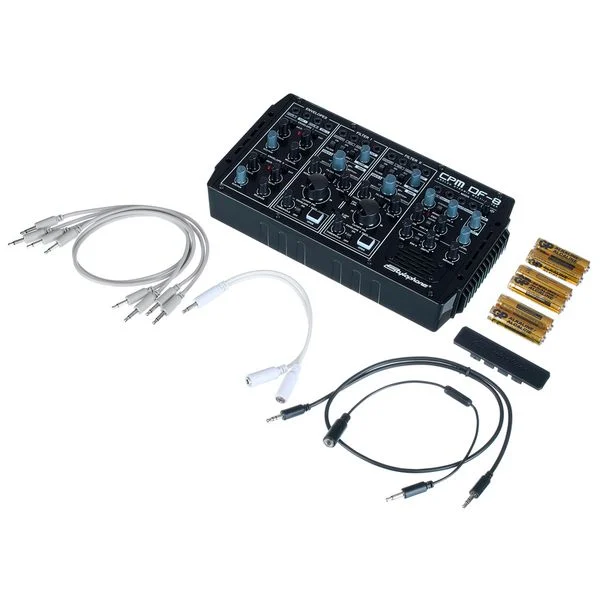
Stylophone CPM DF-8 Compact Modular Analogue Multi-Filter

In stock
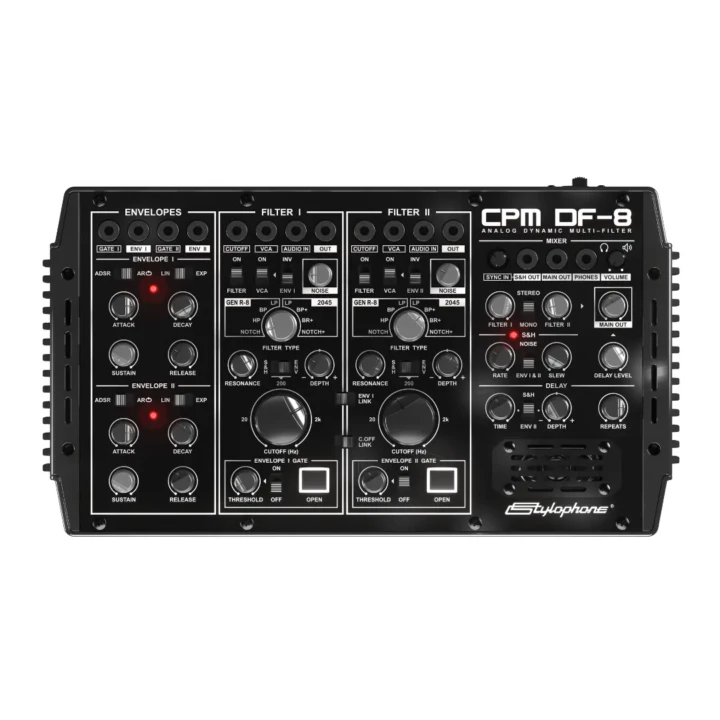
- Two analogue filter channels with 8 filter types each, all able to self-oscillate
- Smooth 2045 24 dB/oct lowpass plus the raw GEN R-8 12 dB/oct multimode filter
- Two ADSR envelopes with gate, audio threshold, manual and looping triggers
- Two noise sources, sample and hold and a modulated PT2399 delay
- 14 patch points, stereo outputs and a built-in 2W speaker
- Runs on 6 x AA batteries, a PSU or Eurorack power (42 HP)
$449 $549
In stock
The Stylophone CPM DF-8 is a compact, portable dual analogue filter from Dubreq, built for synth players, producers, sound designers and modular newcomers who want hands-on filtering for external sounds, a partner for the CPM DS-2 drone synth, or a self-contained noise and texture machine. It runs on batteries, a power supply or a Eurorack power bus, so it works on a desk, on the go or inside a modular case.
Stylophone calls it “the beauty and the beast” of filters: one smooth, classic lowpass and one snarling multimode design, with hybrid modes that combine the two. Add envelopes, VCAs, noise, sample and hold and a delay, and it becomes far more than a filter box.
Two filter characters, eight types per channel
Each of the two identical channels lets you choose between two analogue filter circuits:
- 2045 lowpass (24 dB/oct): a discrete analogue recreation of the classic 2045 lowpass, smooth and round, ideal for warm sweeps and deep bass.
- GEN R-8 (12 dB/oct): Stylophone’s own filter, derived from its GEN R-8 synth, with lowpass, bandpass, highpass and notch modes and an aggressive, characterful resonance.
- Three combination types (12/24 dB/oct): the 2045 lowpass joined with the GEN R-8 highpass to create Bandpass+, Band Reject+ (a phaser-like sound) and a very wide Notch+. Reviewers single these out as the DF-8’s most distinctive voices, as they produce two separate resonant peaks.
Every filter has high resonance and can self-oscillate, so the DF-8 can also act as a sound source on its own. Cutoffs can be linked between the two channels for stereo work.
Envelopes, VCAs and triggering
Two ADSR envelopes, switchable between linear and exponential curves, drive the filters and the two VCAs. Three attenuverters set envelope depth, positive or negative, and the envelopes can be inverted. Each envelope can be triggered four ways:
- A CV gate or trigger patched in from a sequencer or controller
- Incoming audio crossing an adjustable threshold, ideal for drum loops and guitars
- A manual button
- Auto-repeat, a looping AR mode that doubles as an LFO
Four bypass switches let you take the filters and VCAs in and out of the signal path, and the two envelopes can be coupled so one controls both channels.
Noise, sample and hold, and delay
Two white noise sources with their own level controls add percussive hiss, snares and wind effects. A sample and hold source with adjustable slew and a sync input creates stepped or smoothed random modulation, from classic burbles to pinging, telemetry-style tones at high resonance. The vintage PT2399 delay adds lo-fi, slightly crunchy echoes with modulation. A 3-into-1 mixer brings it all together, with stereo or mono output.
Portable, patchable and Eurorack-ready
The DF-8 has 14 3.5mm patch points for audio, envelopes, filters, VCAs and sample and hold, plus a stereo line input, headphone output and a built-in 2W speaker for quick sketches. It runs on six AA batteries, an optional external power supply or a Eurorack power bus, and its 42 HP front panel fits standard Eurorack cases. Stylophone’s ribbed enclosure lets several CPM units lock together side by side into one stable instrument.
Who is it for?
- CPM DS-2 owners: together they form two complete analogue synth voices.
- Producers and DJs who want a hands-on stereo filter for drum machines, synths and samples.
- Ambient, drone and experimental artists who use self-oscillating filters, noise and random modulation as instruments.
- Eurorack users wanting a dense, characterful filter and envelope section in 42 HP.
- Modular beginners who want to learn patching without buying a whole case.
Not the best fit if: you need MIDI control (there is no MIDI, so pitch and gate control needs CV), you want a dedicated LFO or reverb, or you are looking for a sound source with oscillators and a keyboard.
CPM DF-8 vs CPM DS-2
The two units are designed as a pair but do different jobs. The CPM DS-2 is a drone synthesizer: it generates sound with two 3340 analogue oscillators and adds a reverb and delay section. The CPM DF-8 shapes sound: dual multimode filters, envelopes, VCAs, noise and sample and hold, with a delay but no reverb and no oscillators. On its own the DF-8 is a stereo filter effect; with the DS-2 it completes a portable analogue modular system. Browse our synthesizers to pair it with a sound source, or feed it from one of our drum machines.
Tips for getting started
- To filter a drum machine, patch it into the line input, set the trigger mode to audio threshold and turn the threshold up until only the kick or snare fires the envelope.
- For stereo sounds, use the stereo output mode so the two filters sit left and right, and link the cutoffs.
- Turn resonance up on a combination mode and slowly sweep cutoff to hear the two peaks move.
- Use the looping envelope as an LFO for rhythmic filter movement, since there is no separate LFO.
Key Features
- 2 analogue filter channels with high resonance and self-oscillation
- 8 filter types per channel: 4 GEN R-8 (LP, BP, HP, Notch), 2045 LP and 3 combination types (BP+, BR+, Notch+)
- 2 ADSR envelopes with linear and exponential curves
- 4 trigger modes: CV gate, audio threshold, manual button and looping auto-repeat
- 2 VCAs with envelope inverters and 3 envelope depth attenuverters
- 4 bypass switches for filters and VCAs
- 2 white noise sources with level controls
- Sample and hold with adjustable slew and sync input
- Vintage PT2399 delay with modulation
- 3-into-1 mixer with stereo or mono output
- 14 modular patch points, stereo line input and headphone output
- Built-in 2W speaker
- Battery, external PSU or Eurorack power; 42 HP front panel
FAQ
Do I need the CPM DS-2 to use the Stylophone CPM DF-8?
No. The DF-8 works on its own as a stereo filter for any line-level source, such as a synth, drum machine or sampler, and its self-oscillating filters and noise sources can make sound by themselves. The DS-2 is the natural partner if you want a complete portable synth system.
Does the DF-8 have MIDI?
No. It is controlled by CV and gate signals through its patch points, by incoming audio, or by hand. To play it from a MIDI keyboard or DAW you need a MIDI-to-CV converter.
Can I put it in my Eurorack case?
Yes. It has a 42 HP Eurorack front panel and a Eurorack power bus connector, so it can be installed in a standard case as well as used as a desktop unit.
What power options does it have?
Six AA batteries (included), an optional external power supply (sold separately), or Eurorack power when it is mounted in a case.
Can I use it on guitar or vocals?
Yes, any line-level signal can go into the stereo line input, and the audio threshold trigger makes envelope-followed filter effects easy. A guitar straight from its pickups may need a preamp or DI first to reach line level.
| Weight | 0.3 kg |
|---|---|
| Dimensions | 17 × 9 × 2.5 cm |
| brands | Stylophone |
Specifications
| Specification | Details |
|---|---|
| Type | Compact portable modular dual analogue multi-filter |
| Filter channels | 2, analogue, high resonance with self-oscillation |
| Filter types per channel | 8 |
| GEN R-8 filter | 12 dB/oct: lowpass, bandpass, highpass, notch |
| 2045 filter | 24 dB/oct lowpass |
| Combination filters | 12/24 dB/oct: Bandpass+, Band Reject+, Notch+ |
| Envelopes | 2 x ADSR, linear/exponential |
| Trigger modes | CV gate/trigger input, audio input with adjustable threshold, manual button, auto-repeat AR loop |
| VCAs | 2, with envelope inverters |
| Envelope depth controls | 3 attenuverters |
| Bypass switches | 4 (filters and VCAs) |
| Noise | 2 x white noise with level controls |
| Sample and hold | Adjustable slew, sync input |
| Effects | PT2399 delay with modulation |
| Mixer | 3-into-1, stereo or mono output |
| Patch points | 14 x 3.5mm |
| Inputs | Stereo line in, sync in, S&H in/out (3.5mm) |
| Outputs | 2 stereo outputs, headphone output |
| Speaker | Built-in 2W |
| Power | 6 x AA batteries (included), external PSU (not included) or Eurorack power bus |
| Eurorack format | 42 HP |
| Dimensions (W x D x H) | 245 x 132 x 42 mm |
| Weight | 770 g |
Related products
-
Sales, Synthesizers, Top 10dB, UNO Synth Pro deals
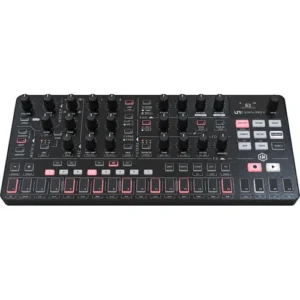
IK Multimedia UNO Synth Pro X – Paraphonic Dual-Filter Analogue Desktop Synthesizer
 Sales, Synthesizers, Top 10dB, UNO Synth Pro deals
IK Multimedia UNO Synth Pro X – Paraphonic Dual-Filter Analogue Desktop Synthesizer
- 3 wave-morphing analogue oscillators with PWM, sync, FM and ring modulation
- Dual filters: 2-pole OTA (LP/HP) plus self-oscillating 2/4-pole SSI low-pass
- 64-step paraphonic sequencer, 10-mode arpeggiator and Bassline mode
- Over 30 hands-on controls, 16-slot modulation matrix and 256 presets
- USB-C, 5-pin MIDI, 2x CV/Gate in and out, audio input
- Just 800 g, powered by the included PSU or USB-C
SKU: IKMT_IP-UNO-SYNTHPROX