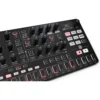
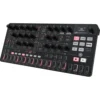
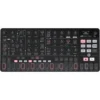
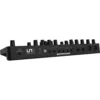
IK Multimedia UNO Synth Pro X – Paraphonic Dual-Filter Analogue Desktop Synthesizer

In stock
- 3 wave-morphing analogue oscillators with PWM, sync, FM and ring modulation
- Dual filters: 2-pole OTA (LP/HP) plus self-oscillating 2/4-pole SSI low-pass
- 64-step paraphonic sequencer, 10-mode arpeggiator and Bassline mode
- Over 30 hands-on controls, 16-slot modulation matrix and 256 presets
- USB-C, 5-pin MIDI, 2x CV/Gate in and out, audio input
- Just 800 g, powered by the included PSU or USB-C
$679 $889
In stock
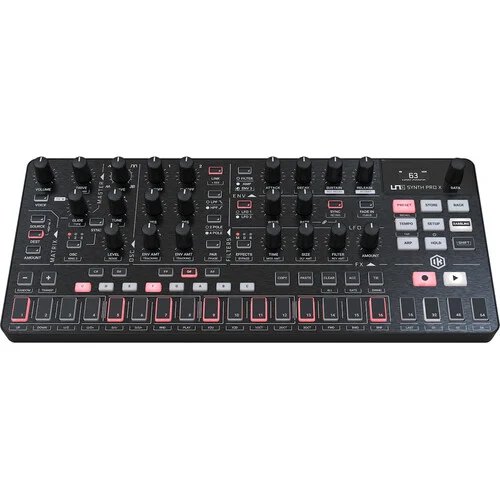
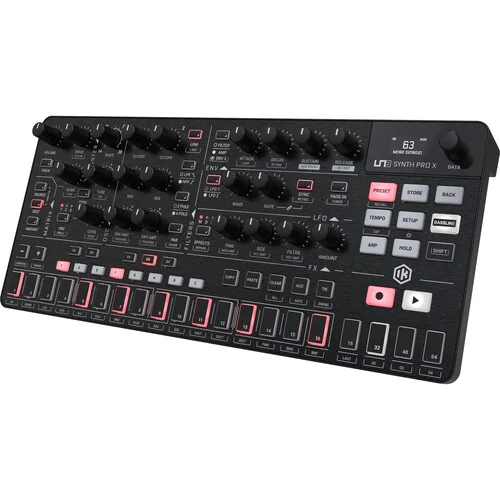
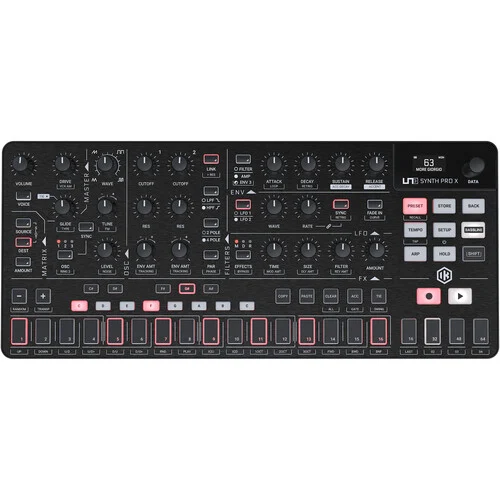
The IK Multimedia UNO Synth Pro X is a compact paraphonic analogue desktop synthesizer for producers, live electronic performers and modular fans who want deep sound design, acid basslines and serious sequencing in a box that weighs about 800 g. It packs three analogue oscillators, two very different filters, three looping envelopes, a 16-slot modulation matrix and a 64-step sequencer into a knob-per-function panel that sits happily beside a laptop.
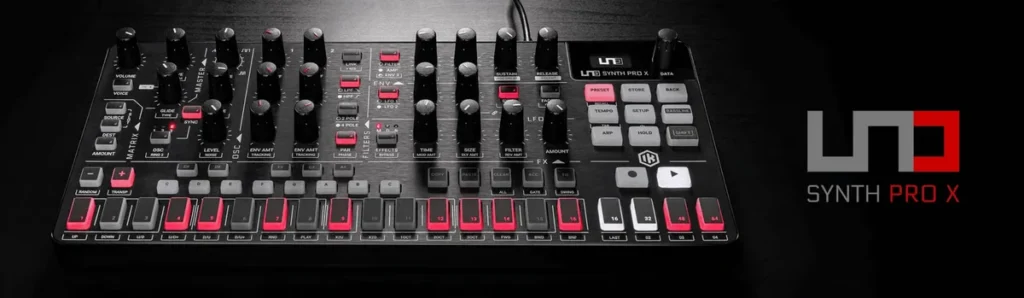
True analogue sound from three wave-morphing oscillators
Each of the three oscillators morphs continuously from triangle through saw and square to a narrow pulse, so you are never stuck with a few fixed shapes. PWM, hard sync, FM and ring modulation are all on board, along with a noise source. Stack the oscillators as one fat mono voice, play smooth leads in legato mode, or switch to paraphonic mode to play up to three notes at once through the shared filter and amplifier, which is ideal for simple pads, intervals and drones.
Dual filters: OTA bite meets SSI smoothness
The filter section is what sets the UNO Synth Pro X apart at this price. Filter 1 is the original UNO two-pole OTA design, switchable between low-pass and high-pass, with a raw, aggressive edge that reviewers compare to the Korg MS-20. Filter 2 is a low-pass filter based on an SSI chip, switchable between 2-pole and 4-pole slopes, and it self-oscillates. Run the two in series or parallel, invert the phase, or press LINK to sweep both cutoffs with a single knob. A dedicated twin-diode analogue drive after the filters adds anything from gentle warmth to full distortion.
Hands-on control with more than 30 knobs and buttons
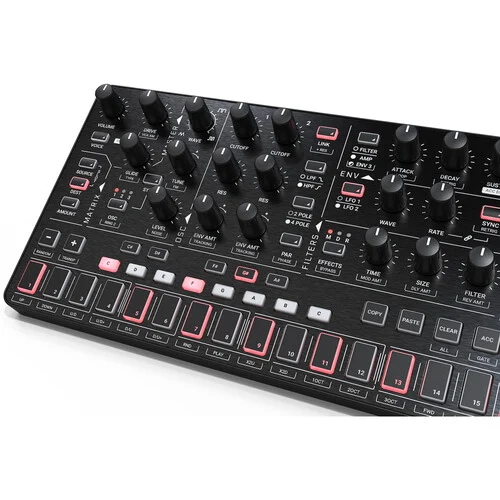
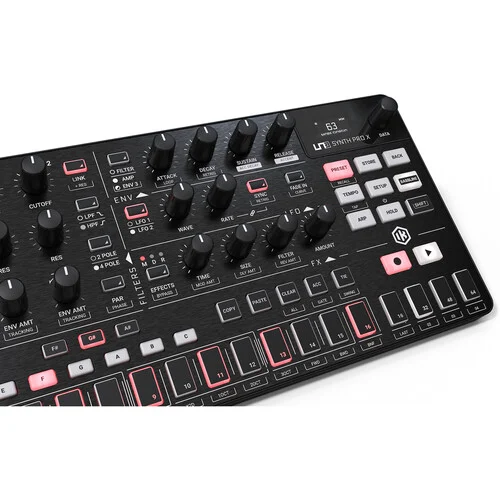
The earlier UNO Synth Pro Desktop relied on a touch grid and shift functions. The Pro X gives nearly every core parameter its own control: oscillator wave, tune and level, both cutoffs and resonances, envelope amounts, the ADSR stages, LFO wave and rate, and the effects. A small OLED screen and data encoder handle presets and global settings, and knob response can be set to absolute, relative or pick-up, so sounds don’t jump when you recall a preset mid-performance.
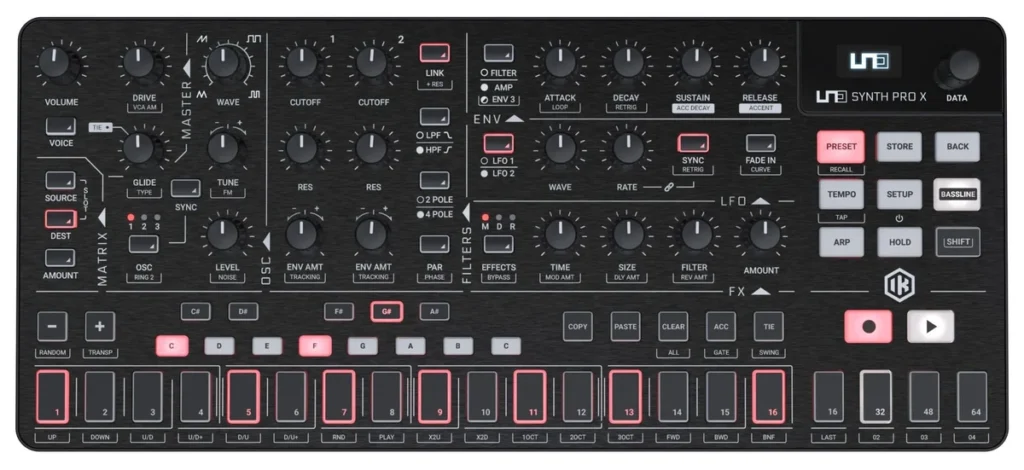
Modulation, envelopes and effects
Three ADSR envelopes (amp, filter and a freely assignable third) all support loop and retrigger, so an envelope can double as an extra LFO. The two LFOs sync to tempo, including your DAW’s tempo over USB, and can fade in over up to 10 seconds. The 16-slot modulation matrix is programmed with three buttons, SOURCE, DEST and AMOUNT, and incoming CV can be used as a modulation source too.
The digital effects section adds chorus (two synth choruses and a string-ensemble style), a UNI-V vibrato/chorus, delay in mono, stereo, doubler, ping-pong and LCR modes, and hall, plate or shimmer reverb. The audio input lets you run external sources through the filters and effects, turning the synth into a creative processor for drum machines or vocals.
64-step sequencer, arpeggiator and Bassline mode
The paraphonic 64-step sequencer fills the lower half of the panel. Enter notes step by step or record in real time, then add per-step parameter automation, accents, ties and gate changes. A random function throws out fresh ideas, presets can recall the sound, the sequence or both, and the 10-mode arpeggiator with HOLD can feed patterns straight into the sequencer.
Bassline mode is inspired by classic acid boxes: it limits the filter range to 5 kHz, turns the envelopes into a two-stage shape and adds accent, so squelchy 303-style lines come together in seconds. Tip: save your preset before entering Bassline mode, because some settings are not restored when you leave it.
Connectivity: USB-C, MIDI, CV/Gate and audio in
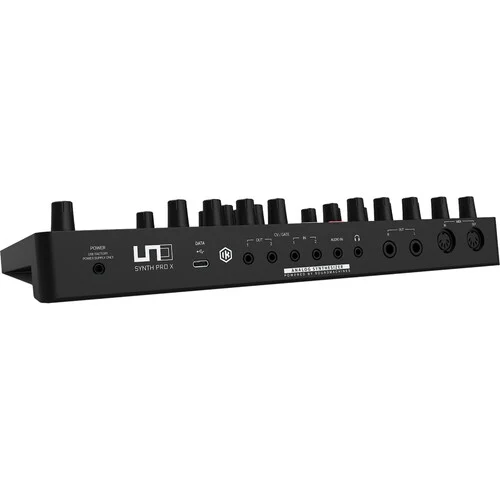
The rear panel covers studio, stage and modular setups. Stereo audio leaves via two balanced 6.35 mm TRS outputs, with a 3.5 mm headphone output for silent practice. Full-size 5-pin MIDI In and Out sit alongside USB-C, which carries MIDI, firmware updates and editor control, and can also power the unit. Two 3.5 mm CV/Gate inputs (-2.5 V to +2.5 V) and two CV/Gate outputs (0 to 5 V) let the sequencer drive Eurorack modules or let your modular system control the synth. Clock can sync via MIDI, USB or analogue. Note that USB is not an audio interface, so record the synth through an audio interface.

Editor and librarian for Mac and Windows
The free UNO Synth Pro X Editor mirrors the hardware panel and adds dedicated pages for the modulation matrix and effects, plus a librarian for organising and backing up the 256 user presets. It runs standalone or as a plug-in inside your DAW, so you can program and automate the synth like a virtual instrument. It needs a 64-bit Mac (macOS 10.15 or later) or 64-bit Windows computer. Presets from the original UNO Synth Pro cannot be transferred to the Pro X.
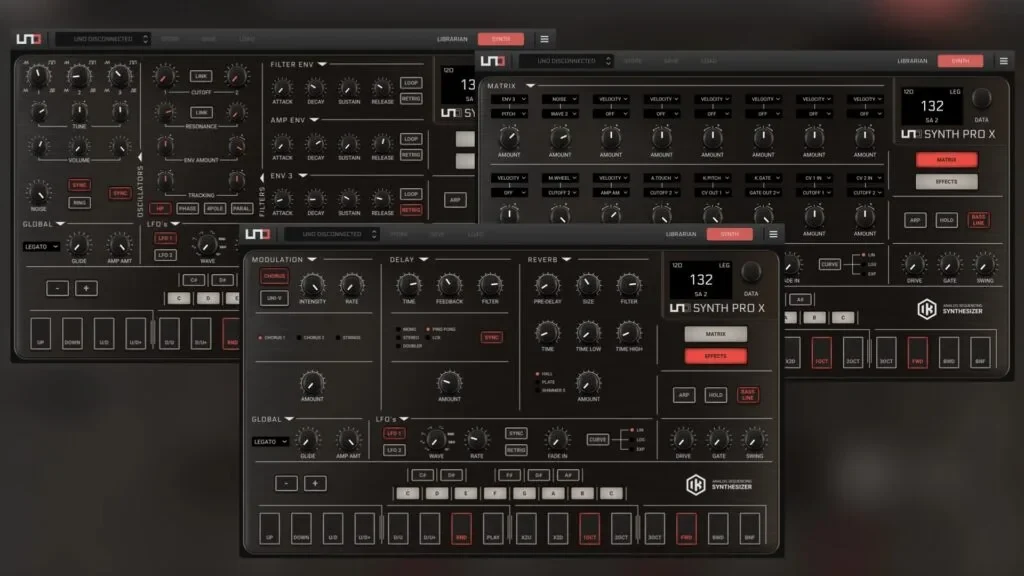
Who is it for?
- Electronic producers who want real analogue bass, leads and sequences without a big footprint.
- Acid and techno artists after 303-style lines with accent, tie and slide-like glide.
- Modular and Eurorack users who need a compact CV/Gate sequencer and voice in one.
- Keyboard players who want a sound module for an existing controller or stage rig.
It is not the right pick if you want a full keyboard built in (the onboard one-octave buttons are for programming and auditioning, so pair it with one of our MIDI keyboards), true polyphonic chords, or USB audio recording.
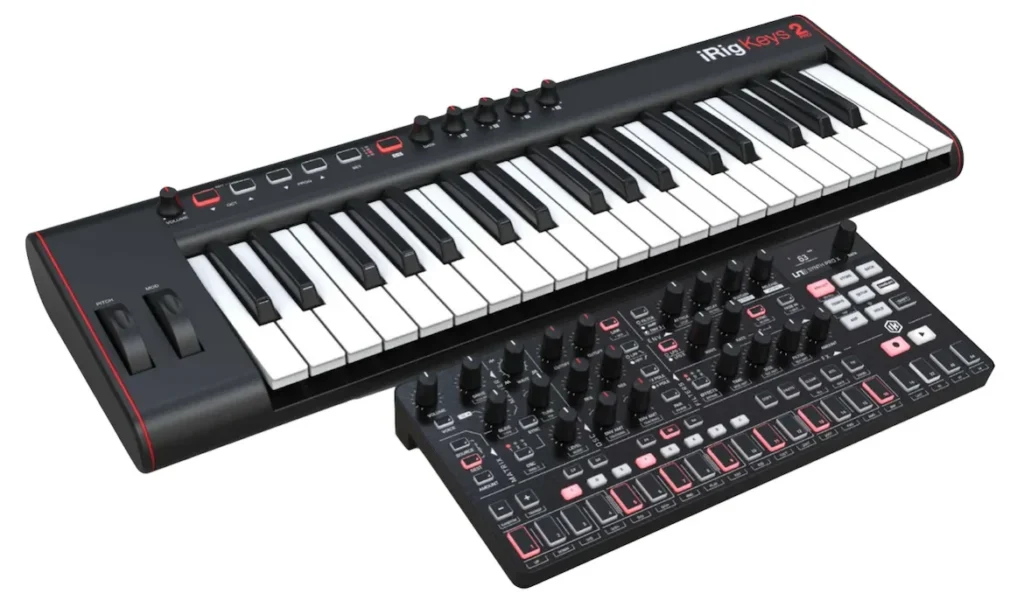
UNO Synth Pro X vs UNO Synth Pro and UNO Synth Pro Desktop
All three share the same three-oscillator, dual-filter, paraphonic engine idea. The UNO Synth Pro has a 37-key Fatar keybed with aftertouch and weighs 5.8 kg, so it suits players who want a keyboard synth. The UNO Synth Pro Desktop uses 32 capacitive touch keys, fewer dedicated controls and micro-USB. The Pro X drops the keys for many more knobs, adds a third assignable envelope, Bassline mode, shimmer reverb, the UNI-V effect, USB-C and an included power supply. If you care most about tweaking and sequencing, the Pro X is the more hands-on choice. Browse more options in our synthesizers range.
Key Features
- 3 discrete wave-morphing analogue oscillators with PWM, sync, FM, ring modulation and noise
- OTA 2-pole LP/HP filter plus SSI-based 2/4-pole self-oscillating low-pass filter
- Series or parallel filter routing with phase invert and cutoff LINK
- Twin-diode analogue drive
- 3 ADSR envelopes with loop and retrigger, 2 tempo-syncable LFOs with fade-in
- 16-slot modulation matrix
- Chorus, UNI-V, delay and reverb (hall, plate, shimmer) effects
- Mono, legato, paraphonic and Bassline voice modes
- 64-step paraphonic sequencer with per-step automation, accent, tie and random
- 10-mode arpeggiator with hold
- 256 user presets with separate sound and sequence recall
- USB-C, 5-pin MIDI In/Out, 2 CV/Gate inputs, 2 CV/Gate outputs, audio input
- Balanced stereo outputs and headphone output
- Free editor/librarian, standalone or plug-in
What’s in the box
- UNO Synth Pro X
- USB-C to USB-C cable (60 cm)
- Power supply unit
- Quick start guide
- Registration card
UNO Synth Pro X FAQ
Does the UNO Synth Pro X have a keyboard?
No. It has a one-octave row of note buttons and 16 step buttons for programming and auditioning. For playing, connect any MIDI keyboard or controller over 5-pin MIDI or USB.
Is the UNO Synth Pro X polyphonic?
It is paraphonic: up to three notes can play at once, but they share the same filter and amplifier. That works well for intervals, simple chords and pads, but it is not a fully polyphonic synth.
Can it run on USB power?
Yes. USB-C power needs at least 5 V / 1.5 A (7.5 W), for example from a capable power bank or charger. IK recommends the included power supply where possible.
Can I record audio over USB?
No. USB carries MIDI, editor data and power only. Connect the balanced outputs to an audio interface or mixer to record it.
Will it work with my Eurorack system?
Yes. Two CV/Gate outputs (0 to 5 V) can drive modules from the sequencer, and two CV/Gate inputs (-2.5 V to +2.5 V) accept modulation or pitch control from your rack.
Can I load my UNO Synth Pro presets?
No. Presets from the UNO Synth Pro and Pro Desktop cannot be transferred to the Pro X, because the sound engines and controls differ.
| Weight | 1 kg |
|---|---|
| Dimensions | 35 × 19 × 6 cm |
| brands | Ik Multimedia |
Specifications
| Specification | Details |
|---|---|
| Synthesis | Analogue, paraphonic (up to 3 notes) |
| Oscillators | 3 wave-morphing analogue oscillators with PWM, sync, FM, ring modulation and noise |
| Filter 1 | 2-pole OTA, low-pass/high-pass, phase invert |
| Filter 2 | SSI-based low-pass, 2-pole/4-pole, self-oscillating |
| Filter routing | Series or parallel, cutoff link |
| Drive | Twin-diode analogue overdrive |
| Envelopes | 3 x ADSR with loop and retrigger |
| LFOs | 2, tempo-syncable, fade-in up to 10 seconds |
| Modulation matrix | 16 slots |
| Effects | Chorus, UNI-V, delay (mono, stereo, doubler, ping-pong, LCR), reverb (hall, plate, shimmer) |
| Voice modes | Mono, legato, paraphonic, Bassline |
| Sequencer | 64-step paraphonic, step and real-time recording, per-step automation |
| Arpeggiator | 10 modes with hold |
| Presets | 256 user-editable |
| Display | OLED screen with data encoder |
| Audio outputs | 2 x 6.35 mm balanced TRS (stereo) |
| Headphone output | 1 x 3.5 mm TRS |
| Audio input | 1 x 3.5 mm |
| CV/Gate inputs | 2 x 3.5 mm TS (-2.5 V to +2.5 V) |
| CV/Gate outputs | 2 x 3.5 mm TS (0 to 5 V) |
| MIDI | 5-pin DIN In and Out, USB MIDI |
| USB | USB-C (MIDI, power, firmware, editor; no audio) |
| Power | iRig PSU-3A (included) or USB-C 5 V / 1.5 A (7.5 W) minimum |
| Dimensions (W x D x H) | 333 x 150 x 50 mm |
| Weight | 800 g |
| Software | UNO Synth Pro X Editor (standalone and plug-in), macOS 10.15+ / Windows 64-bit |
| In the box | UNO Synth Pro X, USB-C to USB-C cable (60 cm), power supply, quick start guide, registration card |
Related products
-
Audio Interfaces, Sales
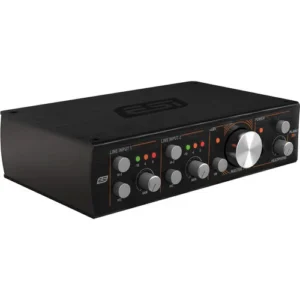
ESI planet 22x Professional Dante Audio Interface with 2 inputs / 2 outputs
- Dante Interface with PoE Support
- 24-Bit / 96 kHz Converters
- Low-Noise, High-Gain Preamplifiers
- Dual XLR-1/4″ Mic/Line/Hi-Z Inputs
- Globally Selectable 48 VDC Phantom Power
- Dual XLR Line Outputs with Level Control
- 1/4″ Headphone Jack with Volume Knob
- Powered via Power Adapter or PoE Source
- Includes Power Supply & Software Bundle
- Compatible with Mac & Windows Computers
SKU: ESIA_PLANET22x -
-