
ART Patch In Compact Pedalboard Patchbay / Insert Point

In stock
- Insert extra pedals anywhere in your chain without rewiring the board
- Self-switching Return jack: patch something in or leave it empty
- Passive signal splitter for two amps or parallel effects
- Makes 4-cable and 2-cable amp connections neat and quick
- Moves your board’s input and output to a handier spot
- Fully passive, no power supply needed
$99
In stock
The ART Patch In is a compact passive patchbay for pedalboards, built for guitarists and bassists who want a flexible insert point, a simple signal splitter or a tidy way to connect a large board to an amp. It sits anywhere in your signal chain and lets you change your setup without pulling the whole board apart.
How the ART Patch In works
The Patch In has an input, a Send, a Return and an Out. The key is the self-switching Return jack, which changes what the unit does depending on whether anything is plugged into it:
- Return connected: your signal leaves through Send, goes through whatever you have patched in, comes back through Return and continues to Out. This is an insert point.
- Return empty: the input feeds both Send and Out at the same time. This turns the Patch In into a passive splitter.
An insert point anywhere on your board
Fixed pedalboards are great until you want to try a new pedal or bring a friend’s effect to a session. Mount the Patch In at the point in the chain where you might want extra effects, for example between your drives and your time-based pedals. On a normal day, a short patch cable or the pedals you usually use go between Send and Return. When you want to add something, you plug it into that loop without lifting a single pedal off the board.
Split your signal to two amps or two paths
With nothing in Return, the same signal comes out of both Send and Out. That lets you run two amplifiers at once, or send one path dry and the other through a different set of effects for parallel processing. Because the split is passive, keep these points in mind:
- Running two amps from one passive split can cause ground-loop hum. An isolated splitter fixes that if it happens.
- Feeding two long cable runs from a passive split puts more load on your pickups, which can take off some top end. A buffer earlier in the chain helps.
If you need isolation, see our signal splitters and isolation range.
Tidy 4-cable and 2-cable amp connections
Many players put drives in front of the amp and modulation, delay and reverb in the amp’s effects loop. That is the 4-cable method, and on a large board it means several long cables to manage. The Patch In helps you organise those connections in one place, whether you run a pre/post layout with the amp’s loop, or an all-pre layout into an amp without a loop, using either the 4-cable or 2-cable method. It also lets you bring the board’s input and output connections to the most convenient edge of a crowded board.
Fully passive
There is no circuitry to power, so the Patch In needs no power supply and takes no output from your pedal power supply. Install it, patch it and forget about it.
Who is it for?
- Good fit: players with fixed or crowded pedalboards who like to add or swap pedals, anyone using the 4-cable method, and players who want a simple way to try two amps.
- Good fit: small boards that need their input and output jacks moved to a handier position.
- Not the best fit: rigs that must run two amps silently every night, which are better served by an isolated or buffered splitter, or anyone who needs switching between loops (a footswitched loop switcher does that job).
Patch In vs a loop switcher
The Patch In has no footswitch: whatever you patch into the insert is always in the signal path until you unplug it. A true bypass loop switcher, such as a single-loop pedal, adds a footswitch so you can bring the loop in and out while playing. Choose the Patch In for a permanent or occasional insert and for splitting; choose a loop switcher for on-the-fly control. Browse more pedalboard tools in our guitar effects pedals, or look at patchbays and routing for studio patching.
Key Features
- Compact pedalboard patchbay and insert point
- Input, Send, Return and Out jacks
- Self-switching Return jack
- Passive splitter mode when Return is empty
- Supports pre/post and all-pre setups with the 4-cable or 2-cable method
- Relocates board input and output connections
- Fully passive, no power required
Why buy from 10dB
Orders leave the 10dB warehouse the same day as your purchase and travel by Australia Post, usually arriving within 3–5 days. For amps to pair with your board, see our guitar amplification range.
FAQ
Does the ART Patch In need power?
No. It is fully passive and works without any power supply.
Can I use the ART Patch In to run two amps?
Yes. Leave the Return jack empty and the signal comes out of both Send and Out. Because the split is passive, you may hear ground-loop hum with some amp combinations; an isolated splitter solves that.
What happens if nothing is plugged into Return?
The self-switching jack sends your input to both Send and Out, so the unit acts as a splitter instead of an insert.
Does it help with the 4-cable method?
Yes. It gives you a single place to organise the connections for pre/post setups with an amp’s effects loop, or all-pre setups into amps without a loop.
Can I switch the insert on and off with my foot?
No. The Patch In has no footswitch. For on-the-fly switching, use a loop switcher instead.
| Weight | 0.226796185 kg |
|---|---|
| Dimensions | 27 × 15 × 8 cm |
| brands | Art Pro Audio |
Specifications
| Specification | Details |
|---|---|
| Type | Passive pedalboard patchbay / insert point / splitter |
| Jacks | Input, Send, Return, Out |
| Return jack | Self-switching |
| Splitter mode | Input feeds Send and Out when Return is empty |
| Amp connection | Pre/post or all-pre, 4-cable or 2-cable method |
| Power | None required (passive) |
Related products
-
-
Patchbays & Routing
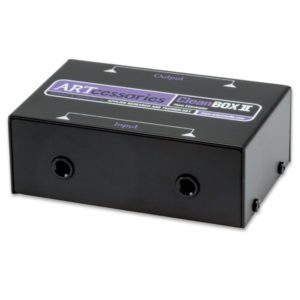
ART CleanBOX II Two-Channel Hum Eliminator
- Removes ground loop hum between audio equipment
- Two channels for stereo or two separate mono signals
- Isolation transformer on each channel
- Passive design: no power supply needed
- 1/4″ TRS inputs and outputs, balanced or unbalanced
- Wide 10 Hz to 50 kHz frequency response
SKU: ARTP_CLEANBOX-2